


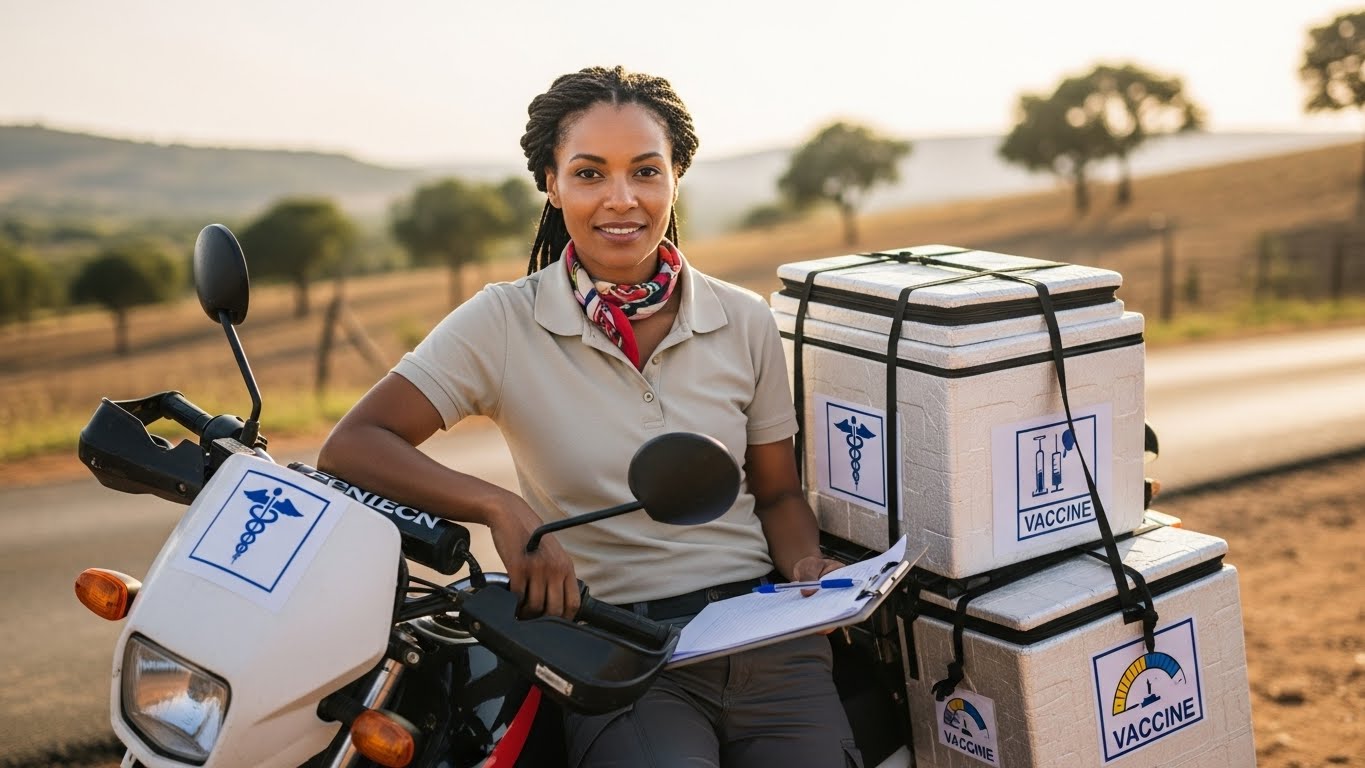
When Norah Magero first built a solar-powered refrigerator in 2016, it wasn’t for vaccines. Dairy farmers in rural Kenya kept asking her the same question: How do we get milk to market before it spoils? As a mechanical engineer, Magero saw a technical problem with a technical solution. She designed a portable fridge that could maintain cold temperatures without electricity, perfect for strapping onto the back of a motorbike.
Then COVID-19 arrived, and everything changed.
Suddenly, the whole world was talking about vaccine distribution. Rich countries stockpiled doses while poorer nations struggled to get shipments. But Magero realized something that most people outside Africa missed: Getting vaccines INTO a country is only half the battle. The bigger challenge is getting them to the people who actually need them, especially when those people live hours away from the nearest health facility and the roads are terrible.
In Kenya, three out of every ten children aren’t fully vaccinated. Not because their parents don’t want them vaccinated. Not because vaccines aren’t available in the capital. But because by the time health workers carry vaccines on bumpy roads to remote villages, they’ve spoiled. Vaccines are fragile. Most need to stay between 2 and 8 degrees Celsius. Any warmer and they become useless. Any colder and they’re damaged.
Traditional vaccine transport in rural Kenya relies on ice boxes. Health workers pack vaccines in coolers filled with ice packs, then make the journey by motorbike or on foot. It sounds simple enough until you remember that rural Kenya is hot, journeys can take hours, and ice melts. By the time a nurse reaches a village three hours away, those vaccines might have spent the last hour sitting in a warm box. She can’t be sure if they’re still good. Often, she has to throw them away just to be safe.
This is where Magero’s VacciBox changes everything.
How a Milk Fridge Became a Vaccine Carrier
The VacciBox is deceptively simple. It’s a portable medical-grade refrigerator powered by solar panels. It weighs about 15 kilograms when full and can be strapped to a motorbike, bicycle, or even a boat. Inside, it maintains temperatures between 2 and 8 degrees Celsius for up to 24 hours without any external power source. The solar panels on top recharge the battery during the day, and the thick insulation keeps everything cold even through the night.
But here’s what makes it brilliant: It was designed for the actual conditions of rural healthcare in Kenya. The roads are rough, so it’s built to absorb shocks. Power is unreliable, so it doesn’t need any. Health workers are busy, so it’s simple to operate with just a power button and a temperature display. And because Magero actually talked to nurses and community health workers before designing it, she knew exactly what they needed.
At Merrueshi Health Centre in Tharaka Nithi County, the difference has been remarkable. This facility serves roughly 400,000 people spread across a huge rural area. Before VacciBox, community health workers struggled to keep vaccines viable during outreach trips. They’d pack traditional coolers and hope for the best, knowing that many vaccines would likely be wasted.
After they started using VacciBox in 2020, vaccination rates at the facility increased by 150 percent. Let me put that in concrete terms: That’s hundreds of children who are now protected against measles, polio, and other preventable diseases. Children who might have died or been disabled are now healthy because a nurse named Rachael can ride her motorbike directly to their villages with vaccines that she KNOWS are still good.
Rachael doesn’t have to guess anymore. She doesn’t have to tell a mother “I’m sorry, I can’t vaccinate your baby today because I’m not sure if these vaccines are still safe.” She just opens the VacciBox, checks the temperature display, and gets to work.
The Numbers That Matter
So far, VacciBox has enabled the safe delivery of over 2.5 million vaccine doses, benefiting more than one million Kenyans. That’s one million people who now have protection against deadly diseases. One million people who might have been left behind by a healthcare system that struggles to reach remote areas.
But Magero isn’t stopping at Kenya’s borders. Her company, Drop Access, is now expanding to Tanzania, Zambia, and Côte d’Ivoire. Each country has similar challenges: Large rural populations, limited electricity infrastructure, difficult terrain, and vaccines that need to stay cold. VacciBox works in all these contexts because it was designed for them from the start.
In 2020, Magero became the first Kenyan and only the second woman globally to win the Africa Prize for Engineering Innovation. The award came with £25,000 in prize money and international recognition, but more importantly, it validated what she already knew: African engineers can solve African problems, often better than anyone else.
Why “Designed in Kenya” Actually Matters
There’s a pattern in global health that people politely call “capacity building” and that really means “Westerners designing solutions for Africans without asking them first.” A nonprofit in London or New York identifies a problem, designs a solution based on what they think will work, flies it to Africa, and then acts surprised when it fails.
Maybe the technology requires reliable electricity that doesn’t exist. Maybe it’s too complicated for health workers who are already stretched thin. Maybe it breaks easily and there’s no one local who knows how to fix it. Maybe it just doesn’t fit how healthcare actually works on the ground.
VacciBox succeeds precisely because it was designed IN Kenya, manufactured IN Kenya, by a Kenyan engineer solving a problem that Kenyans identified. Magero didn’t parachute in with a solution. She lived the problem. She talked to the people experiencing it. She built something that works in the real conditions of rural East Africa, not the imagined conditions of a development office in a Western capital.
This matters more than people realize. When solutions come from within communities, they’re more likely to be appropriate, sustainable, and actually used. When the designer understands the context intimately, they make better choices. And when manufacturing happens locally, repairs and maintenance become possible instead of waiting months for parts to arrive from overseas.
The global health world is finally starting to notice what’s been obvious to people like Magero all along: The best innovations for Africa will come FROM Africa. Not as charity projects, but as commercially viable businesses solving real problems. Not as test beds for Western technology, but as centers of engineering excellence in their own right.
Norah Magero started with dairy farmers and ended up transforming vaccine delivery. She took a simple insight (people need to keep things cold without electricity) and turned it into a tool that has reached one million people and counting. That’s not a feel-good story about “African innovation.” That’s just innovation, period. And it’s rewriting what rural healthcare can look like.
Bio:
Tobi Abiodun edits Global Health Otherwise, a platform dedicated to decolonizing global health narratives and challenging conventional power structures. He curates critical analyses examining whose knowledge counts, how impact is defined, and how to make equity real in research and practice. Through interviews with leading scholars and direct conversations with researchers about their published work, Tobi amplifies African and Global South scholarship while critically examining power dynamics in health systems, diplomacy, and methodology. His editorial work centers Global Health Otherwise’s mission: dismantling outdated hierarchies and making equity a daily practice rather than an aspirational goal in global health discourse and implementation.