


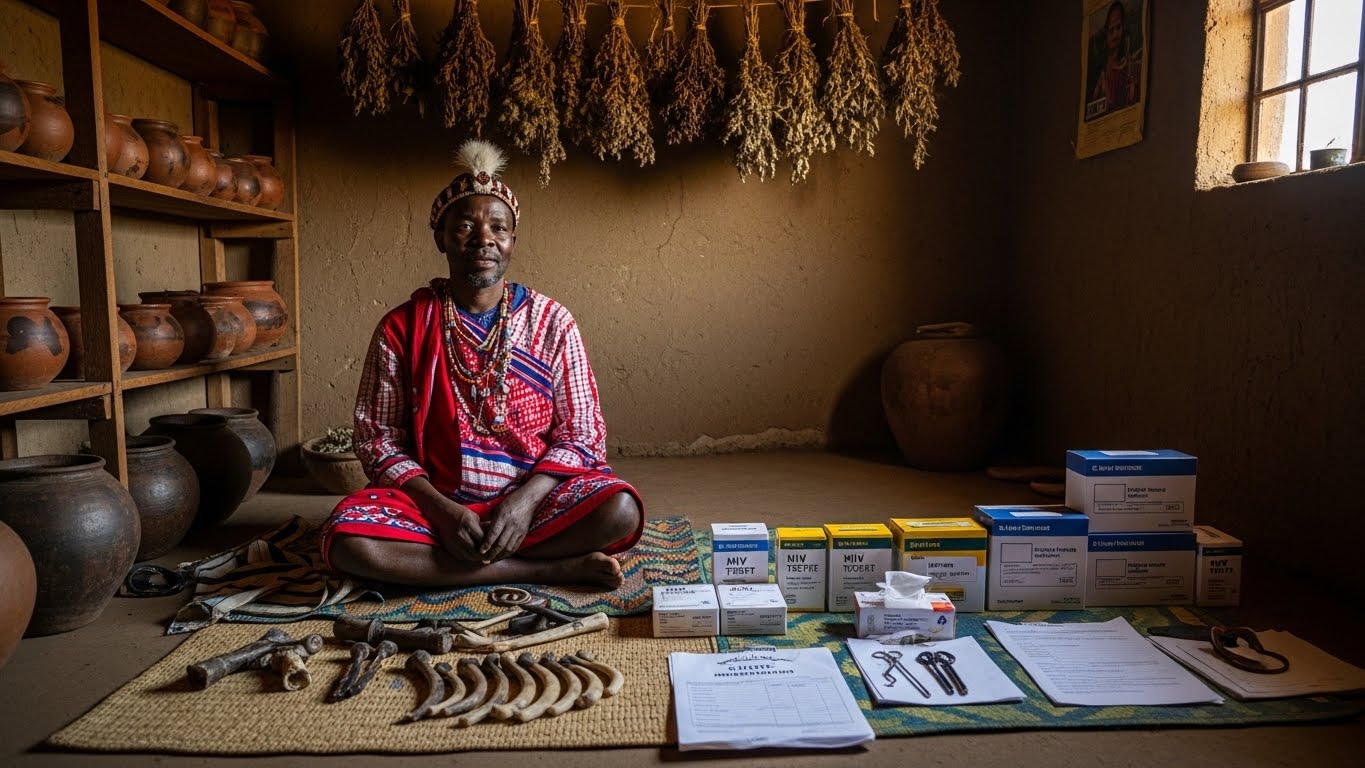
Mawelele sits in his consultation room in Bushbuckridge, South Africa, surrounded by the tools of his trade. There are herbs hanging from the ceiling, traditional medicines in clay pots, and divination bones on a woven mat. But there’s also something you might not expect: HIV testing kits and referral forms for the local clinic.
He’s a sangoma, a traditional healer who communicates with ancestors to diagnose illness and prescribe treatment. He’s also, as of last year, part of a pilot program that’s quietly revolutionizing how South Africa thinks about healthcare. In the past twelve months, Mawelele has referred more than 40 patients to local clinics for HIV testing, merging two systems of medicine that have often viewed each other with suspicion.
Here’s the thing most outsiders miss about African healthcare: When we talk about “universal health coverage,” we’re usually talking about building more clinics, training more doctors, expanding insurance schemes. All of that matters. But in South Africa, 70 percent of people visit traditional healers before or instead of going to a medical doctor. In some rural areas, that number is even higher.
So if you’re serious about reaching everyone with healthcare, you can’t ignore the healers who are already doing most of the work.
The System That Already Exists
Traditional healers like Mawelele aren’t a quaint remnant of the past that will fade away once “real” medicine arrives. They are the primary healthcare providers for the majority of South Africans right now, today. They’ve been here for centuries. They’ll be here for centuries more.
There are an estimated 200,000 traditional healers practicing in South Africa, compared to about 45,000 Western-trained doctors and nurses. The math is simple: Traditional healers vastly outnumber biomedical practitioners, especially in rural areas where clinics are few and far between. They’re also more accessible. They speak local languages. They understand cultural contexts. They don’t require appointments booked weeks in advance. And crucially, they address aspects of illness that Western medicine often dismisses.
Traditional African healing systems view illness holistically. A person might be sick because of a physical problem, yes, but also because of spiritual imbalance, broken relationships with ancestors, or social conflicts in the community. Traditional healers treat illness through both physical and spiritual means, using herbs alongside rituals, divination alongside counseling. They don’t separate the body from the spirit the way Western medicine does.
This isn’t superstition. This is a sophisticated medical system with its own internal logic, diagnostic methods, and treatment protocols. It’s different from biomedicine, not inferior to it.
When Two Systems Meet
The pilot program that Mawelele joined represents a fundamental shift in how South Africa thinks about these two medical systems. Instead of treating traditional healing as something to overcome or replace, the program asks: What if they worked together?
The model is straightforward. Traditional healers receive training on how to recognize symptoms of HIV and other conditions that require biomedical intervention. They’re given testing kits and referral forms. When a patient comes to them with symptoms that suggest HIV, the healer can offer an on-the-spot test. If it’s positive, they refer the patient to a clinic for antiretroviral treatment. But they don’t stop being the patient’s healer. They continue providing spiritual and social support, helping the patient navigate both the medical system and the community stigma that often comes with an HIV diagnosis.
This isn’t theoretical. It’s working. In the Bushbuckridge study, traditional healers successfully referred patients to clinics, and those patients actually went. That last part matters enormously. One of the biggest challenges in HIV treatment is getting people diagnosed and into care. If a person trusts their traditional healer and that healer says “You need to go to the clinic,” they’re much more likely to go than if a clinic simply puts up posters urging people to get tested.
Ghana has taken this integration even further. Forty medical centers now have herbalists working side by side with Western-trained doctors, and the government reimburses consultations with traditional healers through the national health insurance scheme. Patients can see both a doctor and a herbalist at the same facility, covered by the same insurance. The herbalists aren’t assistants or cultural consultants. They’re full members of the healthcare team with their own consultation rooms and patient loads.
In some Ghanaian hospitals, doctors refer patients to herbalists for certain conditions, particularly chronic illnesses where Western medicine has limited success. The herbalists refer patients to doctors when they identify problems that require surgery or pharmaceutical intervention. They collaborate on treatment plans. They learn from each other.
Recognition, Not Validation
South Africa is now following Ghana’s lead. Starting in 2025, new regulations require traditional healers to register with the Interim Traditional Health Practitioners Council, giving them formal recognition similar to that of doctors and nurses. They’ll need to meet certain standards, maintain ethical guidelines, and participate in continuing education. In return, they’ll be officially recognized as legitimate healthcare providers.
This is where we need to be careful with language. It’s tempting to call this “legitimizing” traditional healing or “giving Indigenous knowledge a seat at the table.” But that framing reveals a bias. It assumes Western medicine is the default, the standard against which everything else must be measured. It assumes traditional healers need permission from biomedical authorities to be real healthcare providers.
Mawelele was already legitimate. He’s been healing people for years. His patients already trusted him, already saw him as their primary healthcare provider. The new regulations don’t make him legitimate. They make him legally recognized by a government system that was, until recently, pretending he didn’t exist.
This distinction matters. Indigenous medical knowledge doesn’t need validation from Western science. It has its own evidence base, accumulated over centuries of practice and passed down through generations of healers. When Mawelele uses specific herbs for specific conditions, he’s not guessing. He’s applying knowledge that has been tested and refined over hundreds of years.
The question isn’t whether traditional healing “works” by Western scientific standards. The question is: Why does Western medicine get to be the judge? Why is the randomized controlled trial the only acceptable form of evidence? Why do we demand that Indigenous knowledge systems prove themselves using methods developed in European universities?
Who’s Integrating Into What?
Here’s the uncomfortable truth: Most discussions about “integrating traditional and Western medicine” assume that traditional healing will be absorbed into Western systems. Traditional healers will learn to refer patients to clinics. They’ll learn to recognize conditions that require biomedical treatment. They’ll become, essentially, community health workers who happen to use herbs.
But integration should go both ways. Western-trained doctors should learn from traditional healers about holistic approaches to illness. They should understand how spiritual and social factors affect health. They should recognize that their way of practicing medicine is also culturally specific, not universal truth.
In the Bushbuckridge program, that two-way learning is starting to happen. Clinic staff are learning to ask patients if they’re also seeing a traditional healer and to coordinate care rather than demand that patients choose one or the other. They’re recognizing that most of their patients don’t see these systems as contradictory. A person can take antiretroviral drugs for HIV and also consult a sangoma about the spiritual dimensions of their illness. Both can be true at the same time.
This is important for practical reasons. If a patient is taking both pharmaceutical medications and traditional medicines, healthcare providers need to know that to avoid dangerous interactions. But it’s also important symbolically. It signals respect for patients’ choices and recognition that healing happens in multiple dimensions.
The Path Forward
South Africa’s new regulations are imperfect. There are legitimate questions about how to verify traditional healers’ training in systems that have historically been oral and apprenticeship-based. There are concerns about imposing Western bureaucratic standards on Indigenous practices. Some traditional healers worry that registration requirements will undermine their autonomy or force them to practice in ways that contradict their training.
But the alternative is worse. Continuing to pretend that 70 percent of South Africans aren’t relying on traditional healers for their primary healthcare. Continuing to exclude traditional healers from national health conversations while wondering why health programs don’t reach rural communities. Continuing to treat Indigenous medical knowledge as something to be overcome rather than something to learn from.
Mawelele’s 40 referrals in one year might not sound like much compared to the scale of South Africa’s HIV epidemic. But multiply that by thousands of traditional healers across the country, and you start to see the potential. You start to see a healthcare system that actually reflects how most Africans think about health and healing. Not Western medicine with a side of traditional knowledge as a cultural accommodation. Not traditional healing trying to prove itself worthy by Western standards. But two sophisticated medical systems working together, learning from each other, and serving patients better than either could alone.
The real innovation here isn’t teaching traditional healers to use HIV test kits. The real innovation is a healthcare system that finally recognizes what patients have known all along. Healing requires more than pills and procedures. It requires addressing the whole person in all their complexity, spiritual, physical, and social. Traditional healers have been doing that for centuries. Maybe it’s time Western medicine caught up.
Bio:
Tobi Abiodun edits Global Health Otherwise, a platform dedicated to decolonizing global health narratives and challenging conventional power structures. He curates critical analyses examining whose knowledge counts, how impact is defined, and how to make equity real in research and practice. Through interviews with leading scholars and direct conversations with researchers about their published work, Tobi amplifies African and Global South scholarship while critically examining power dynamics in health systems, diplomacy, and methodology. His editorial work centers Global Health Otherwise’s mission: dismantling outdated hierarchies and making equity a daily practice rather than an aspirational goal in global health discourse and implementation.