



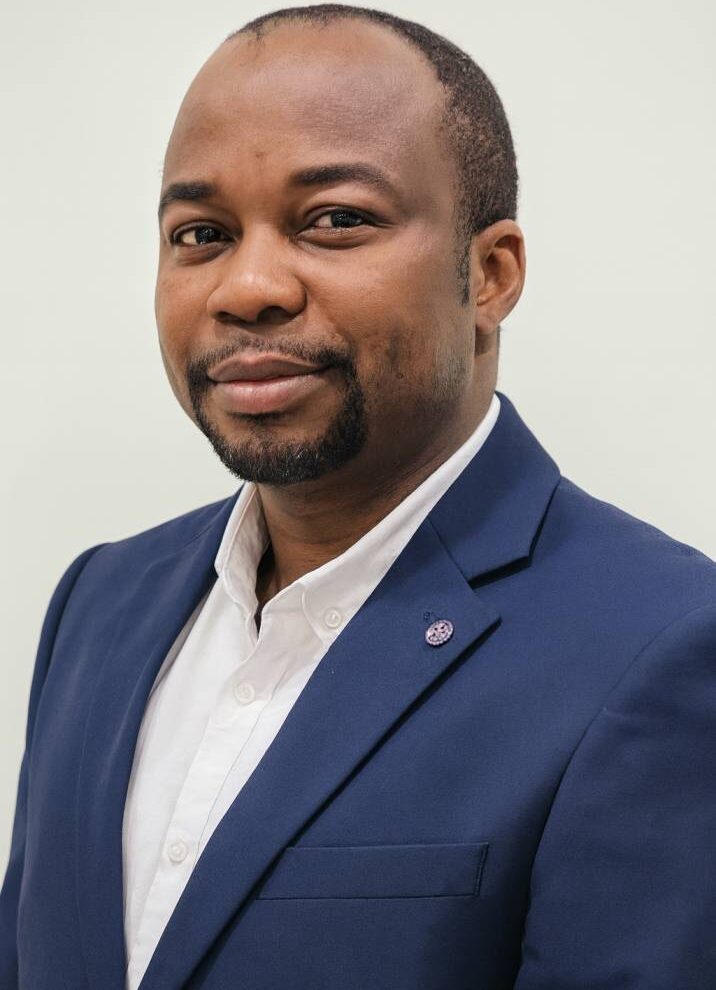
Clinical and positive psychologist Richard Appiah joins us from the University of Ghana and Northumbria University to discuss his work reimagining ethics frameworks, the power of Indigenous knowledge systems, and why the future of global health depends on co-creating solutions with communities rather than for them.
Global Health Otherwise: You’re bridging clinical psychology, positive psychology, health psychology, and global health. What draws these fields together in your work?
Richard Appiah: They converge at the intersection of ethics and culture. My training across these disciplines revealed a fundamental mismatch: Western ethical frameworks designed around individual autonomy don’t fit communities where decision-making is relational, interdependent, and guided by tradition. Working in rural and peri-urban Ghana with chiefs, elders, and local groups, I’ve seen how informed consent needs to operate differently in communal societies. It’s not about abandoning scientific integrity. It’s about recognizing that diverse cultural epistemologies are legitimate foundations for ethical research.
Global Health Otherwise: What does it take to build a meaningful career in culturally responsive global health research?
Richard: Genuine respect for the communities you work with. Technical expertise matters, but what truly sustains you is the ability to listen deeply and question your assumptions. You need patience to build trust one conversation at a time, and courage to challenge frameworks that no longer serve the contexts we work in. Adaptability is crucial. No two communities operate the same way, so your methods must reflect that. Above all, hold onto humility. Your greatest insights will come from unexpected moments with community members and local leaders who understand the realities far better than any textbook.
Global Health Otherwise: Where do you see the biggest failures in current global health ethics?
Richard: The assumption that Western, autonomy-driven ethics can simply be transplanted into African contexts without adaptation. Decision-making in many communities is inherently relational, shaped by kinship structures, local leadership, spirituality, and collective obligations. Yet our guidelines continue to prioritize the individual as the sole moral agent. This creates confusion, undermines trust, and leads to practices that feel extractive or disrespectful. We need to recognize relational autonomy as equally legitimate and develop informed consent processes that are dialogical, communal, and culturally grounded.
Global Health Otherwise: Tell us about the ETHICS-GUIDE Project. What made it successful?
Richard: ETHICS-GUIDE was transformative because we worked hand-in-hand with communities from the start. In Bimoba and Mamprusi communities, we co-designed informed consent frameworks that genuinely reflected their cultural values, spiritual worldviews, and communal decision-making processes. What began locally expanded to tailored frameworks for all 16 major ethnic groups in Ghana, each shaped by community voices and grounded in Indigenous ethics. For many participants, it was the first time they’d seen their cultural norms recognized as legitimate foundations for ethical research. The sense of ownership was palpable.
Global Health Otherwise: You’ve developed “Proverbial Positive Psychology.” How does that work?
Richard: Carefully selected proverbs carry behavioral guidance that feels intuitive and locally meaningful. For example, “One hand washes the other, and together, they wash the face” reinforces cooperation, mutual support, and shared responsibility in mental health interventions. The CAPPI framework I developed offers a structured process for selecting culturally relevant proverbs, mapping them onto psychological constructs, and embedding them naturally into program activities. Innovation doesn’t always require sophisticated technology. Often, it begins with rethinking whose knowledge shapes interventions and who gets to define the problem.
Global Health Otherwise: What have community-led interventions taught you?
Richard: That they work better. In the Escaping Poverty Project, we developed a strengths-based mental health intervention for 2,000 participants across 165 rural communities. The once-weekly group sessions helped build confidence, strengthen relationships, and increase vocational productivity. The Inspired Life Programme blended constructs and principles of positive psychology and cognitive behavioral interventions with local proverbs and narratives, making it deeply resonant. The Pempamsie Family Programme taught and practiced skills in stress management, relationships and communication, and healthy, non-violent strategies to manage adolescent problem behaviors, thereby strengthening parenting and family well-being. Across all these projects, one lesson is clear: when communities lead the process, outcomes are not only effective. They remain sustainable, trusted, and owned by the people themselves.
Global Health Otherwise: What advice would you give to policymakers?
Richard: Recognize that ethical frameworks and behavioral interventions cannot be imported. They must be built with communities, not around them. Invest in participatory processes that bring chiefs, elders, youth, and local professionals into the earliest stages of program design, not as a late-stage formality. Create space in national ethics guidelines for relational autonomy and culturally grounded consent models. Fund research that validates Indigenous knowledge systems and rigorously evaluates community-led innovations. Effective policy must move beyond compliance toward genuine partnership, recognizing that communities hold ethical wisdom that can strengthen global health far more than any external blueprint.
Global Health Otherwise: Looking ahead, what changes do you anticipate?
Richard: We’re moving toward a global health ecosystem where ethics will no longer be treated as a fixed export but as a negotiated, culturally situated practice. The growing recognition of relational autonomy and Indigenous moral systems will push institutions to adopt context-responsive frameworks. In the next decade, we’ll likely see more countries developing their own culturally aligned consent guidelines, co-authored by local leaders, researchers, and ethics bodies. Digital innovations will expand possibilities, but only if they embody cultural sensitivity rather than just technological novelty. The future will be defined by partnership. Communities asserting agency, researchers embracing shared authority, and institutions acknowledging that ethical practice must begin with local wisdom.
Global Health Otherwise: Any final advice for those entering this field?
Richard: Enter with an open mind and willingness to unlearn as much as you learn. Some of the most important lessons come from sitting with communities, listening to their stories, and recognizing knowledge that doesn’t appear in academic journals. Don’t rush the work. Building trust takes time, and meaningful change grows from relationships, not quick wins. Let humility guide your interactions, curiosity lead your questions, and your ethical compass remain steady when the work becomes complex. Remember that impact isn’t measured only in publications but in how respectfully and responsibly you show up in the spaces you’re invited into. If you commit to centering justice, cultural humility, and community voice, you’ll help build a field that is not only scientifically rigorous but also deeply human and profoundly transformative.
Editor’s Bio:
Tobi Abiodun edits Global Health Otherwise, a platform dedicated to decolonizing global health narratives and challenging conventional power structures. He curates critical analyses examining whose knowledge counts, how impact is defined, and how to make equity real in research and practice. Through interviews with leading scholars and direct conversations with researchers about their published work, Tobi amplifies African and Global South scholarship while critically examining power dynamics in health systems, diplomacy, and methodology. His editorial work centers Global Health Otherwise’s mission: dismantling outdated hierarchies and making equity a daily practice rather than an aspirational goal in global health discourse and implementation.
Expert’s Bio:
Richard Appiah, Ph.D., FHEA, ClinPsych is affiliated with the University of Ghana, the University of Johannesburg, and Northumbria University. His research focuses on culturally responsive ethics frameworks and strengths-based mental health interventions in African contexts. Learn more about his work at the College of Health Sciences, University of Ghana and Northumbria University.